
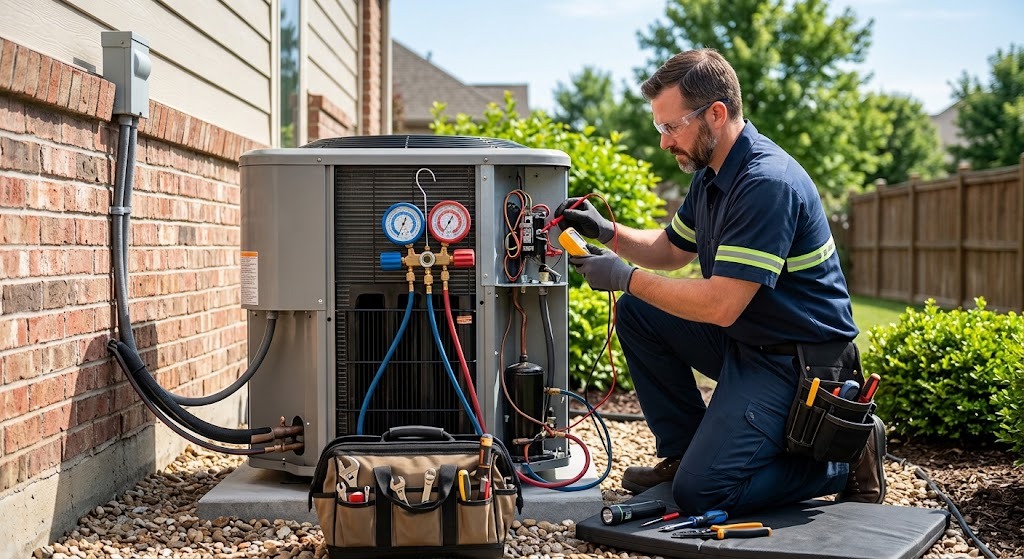
If your air conditioner has started blowing warm air, cycling on and off, or making strange noises, the first question on your mind is probably: how much is this going to cost me? San Diego’s mild coastal climate might not feel as brutal as the desert heat of Phoenix or Las Vegas, but our inland neighborhoods regularly see summer temperatures climb into the 90s, and a broken AC system during a heat wave is never convenient. At Reliable Standard Heating & Air, we get calls every week from homeowners across San Diego County who want a straight answer before they commit to a repair. This guide breaks down what actually drives the price of AC repair in San Diego, so you can budget with confidence and avoid overpaying.
The Short Answer: Typical AC Repair Costs in San Diego
Most homeowners in San Diego pay somewhere between $150 and $600 for a common AC repair. Minor fixes, like replacing a capacitor, cleaning a clogged drain line, or resetting a faulty thermostat, tend to land on the lower end of that range, often between $89 and $300. More involved repairs, such as replacing a blower motor, repairing refrigerant leaks, or fixing a failing evaporator coil, can run $800 to $2,500. And if the problem turns out to be a failing compressor, the most expensive component in the system, repair costs can climb to $1,500 to $3,500 or more, at which point many homeowners start weighing repair against replacement.
Diagnostic fees are also part of the equation. Most HVAC companies in the area charge somewhere between $75 and $150 just to send a technician out and identify the problem, though many companies apply that fee toward the final repair cost if you move forward with the work. You can see a full breakdown of typical repair pricing by issue on air conditioning repair cost, which we update regularly to reflect current parts and labor rates in the San Diego market.
What Actually Drives the Cost of Your Repair
No two AC repairs are identical, and the final invoice depends on several factors working together.
1. The specific component that failed. Electrical parts like capacitors, contactors, and relays are relatively inexpensive to replace and quick to install, which keeps labor costs down. Mechanical components like compressors, blower motors, and evaporator coils involve more labor time, specialized tools, and pricier parts, which pushes the total higher.
2. Refrigerant type and availability. Older systems that still use R-22 refrigerant (commonly known as Freon) can be significantly more expensive to service because that refrigerant has been phased out and is increasingly hard to source. Newer systems using R-410A or R-32 refrigerant are generally more affordable to recharge.
3. Age and brand of your system. Parts for older or less common HVAC brands can take longer to source, which sometimes adds to labor time and cost. Systems that are still under manufacturer warranty may only require you to pay for labor, which can cut your out-of-pocket cost substantially.
4. Accessibility of the unit. If your outdoor condenser or indoor air handler is tucked into a tight attic space, a rooftop location, or a hard-to-reach closet, technicians need more time to complete the repair safely, which can add to labor charges.
5. Time of year and demand. Like most HVAC contractors, we see a spike in service calls during peak summer months. Scheduling non-emergency maintenance and repairs in the spring or fall, before the heat sets in, can sometimes mean shorter wait times and more flexible scheduling.
6. Emergency or after-hours service. If your system fails on a Saturday night in July, expect to pay a premium for emergency dispatch compared to a standard weekday appointment.
Common San Diego AC Problems and What They Typically Cost
Refrigerant leaks: Low refrigerant is one of the most frequent reasons San Diego homeowners call for AC repair, especially in older systems. Locating and sealing the leak, then recharging the system, typically runs $200 to $800 depending on the extent of the leak and the type of refrigerant.
Capacitor failure: Capacitors help start and run your compressor and fan motors. When they wear out, your AC may hum but not start, or the fan may run without cooling. This is one of the most common and least expensive repairs, usually $150 to $400.
Frozen evaporator coil: A coil covered in ice is often a sign of restricted airflow, low refrigerant, or a dirty filter. Diagnosing and correcting the underlying cause typically costs $150 to $600, though a full coil replacement can run considerably higher.
Compressor issues: As the heart of the outdoor unit, a failing compressor is the costliest single repair, often $1,500 to $3,000 or more. Because compressors are expensive and labor-intensive to replace, our technicians will always walk you through whether repair or full system replacement makes more financial sense based on your system’s age.
Thermostat malfunctions: Sometimes the AC unit itself is fine, and the culprit is a miscalibrated or dying thermostat. Replacement is usually one of the more affordable fixes, generally under $300 including labor.
Repair vs. Replace: Knowing When to Walk Away
A helpful rule of thumb in the HVAC industry is the “50% rule.” If your system is more than 10 years old and the repair estimate exceeds roughly half the cost of a full replacement, it’s usually smarter to invest in a new, more efficient system rather than continuing to patch an aging unit. Older systems also tend to run on outdated refrigerant, use less efficient compressors, and cost more to operate month to month, so repeated repairs can end up costing more over time than a single upfront replacement.
Our technicians will never push a replacement you don’t need. We’ll give you an honest assessment of your system’s remaining lifespan, current efficiency, and repair history so you can make the call that fits your budget and your home.
How to Keep Repair Costs Down
Preventive maintenance is the single best way to avoid expensive AC repairs in San Diego. A seasonal tune-up, which typically costs far less than a major repair, allows a technician to catch small issues like a slightly low refrigerant charge, a worn capacitor, or a dirty coil before they turn into a system failure during the hottest week of the year. Simple habits also help: changing your air filter every one to three months, keeping the outdoor condenser clear of debris and landscaping, and scheduling an annual inspection can meaningfully extend the life of your system and reduce the odds of a surprise breakdown.
Get a Straightforward Quote from a Local Team
Every San Diego home is a little different, and the only way to get an accurate number for your specific situation is to have a licensed technician take a look. At Reliable Standard Heating & Air, our team has diagnosed and repaired thousands of AC systems across San Diego County, from coastal neighborhoods dealing with corrosion to inland communities running their units hard through the summer. We provide upfront pricing before any work begins, so you’ll never be surprised by your final bill.
If your air conditioner is acting up, don’t wait for a full breakdown during the next heat wave. Visit our air conditioning service page to learn more about our repair process, or give our team a call to schedule a diagnostic visit. We’re proud to be a trusted, reliable choice for San Diego homeowners who just want honest pricing and quality work.